Three Ghalib Couplets: Meanings and Ideas for Your Wall
By Lafz. 24 October 2026, 3 min read.
Ghalib's poetry often holds two feelings together: desire and disappointment, humour and vulnerability, remembrance and absence. These three couplets offer different ways into his work, and different moods for a poetry print.
The English explanations below are our own plain-language readings, not quotations from a published translation. A couplet can support more than one interpretation; the linked literary texts let you explore the wider ghazal. Roman Urdu spelling also varies, so you may encounter slightly different spellings of the same words.
1. Hazaaron Khwahishen: desire that keeps returning
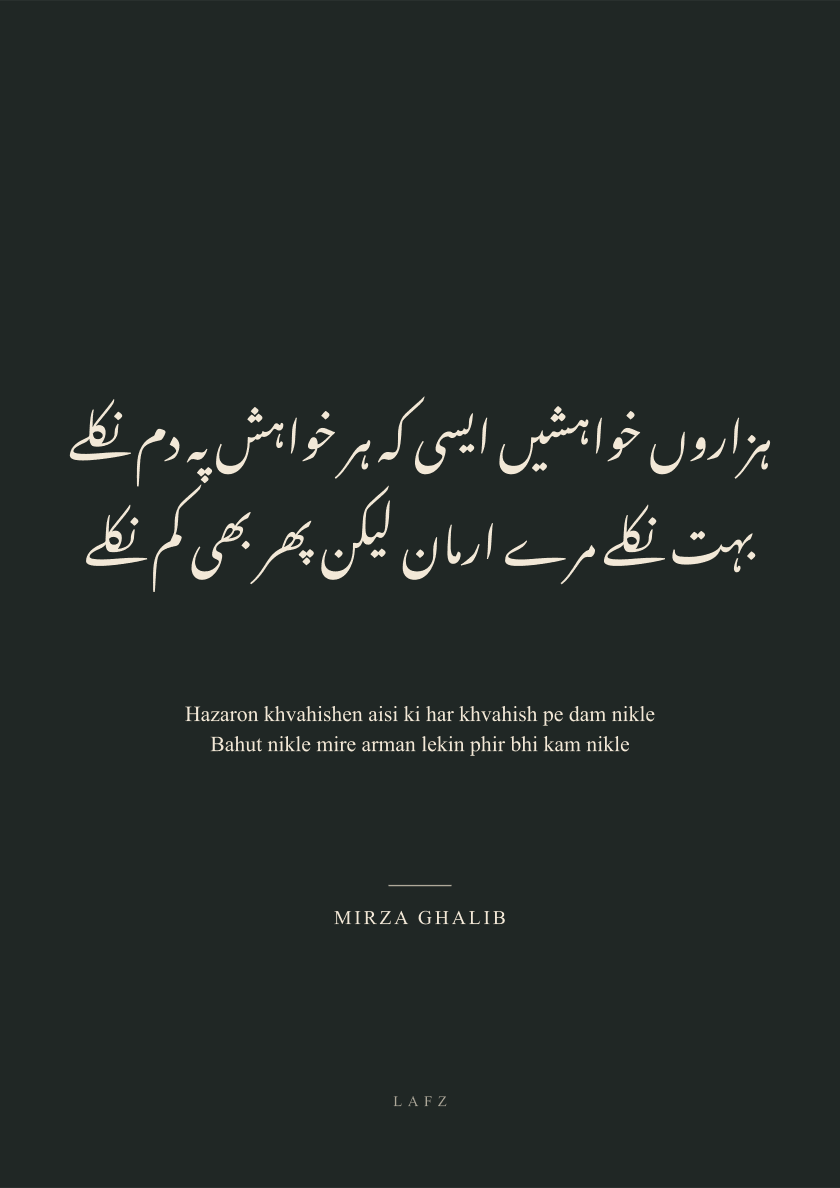
Hazaron khvahishen aisi ki har khvahish pe dam nikle
Bahut nikle mire arman lekin phir bhi kam nikle
Plain-English meaning: There are countless desires, each intense enough to overwhelm me. Many of my wishes have been fulfilled, yet they still feel too few.
The second line changes how we hear the first. This is not simply a wish for more possessions or a cheerful instruction to dream bigger. Fulfilment has already happened, but it has not ended desire. That makes the couplet familiar to anyone who has reached a goal and then discovered a new restlessness.
On a wall, the verse can invite reflection rather than act as a productivity slogan. It may suit a reader who enjoys Ghalib's self-awareness or a workspace where ambition is accompanied by a little perspective.
Read the literary text of the ghazal, or explore the Hazaaron Khwahishen print.
2. Ishq Par Zor Nahin: love beyond command
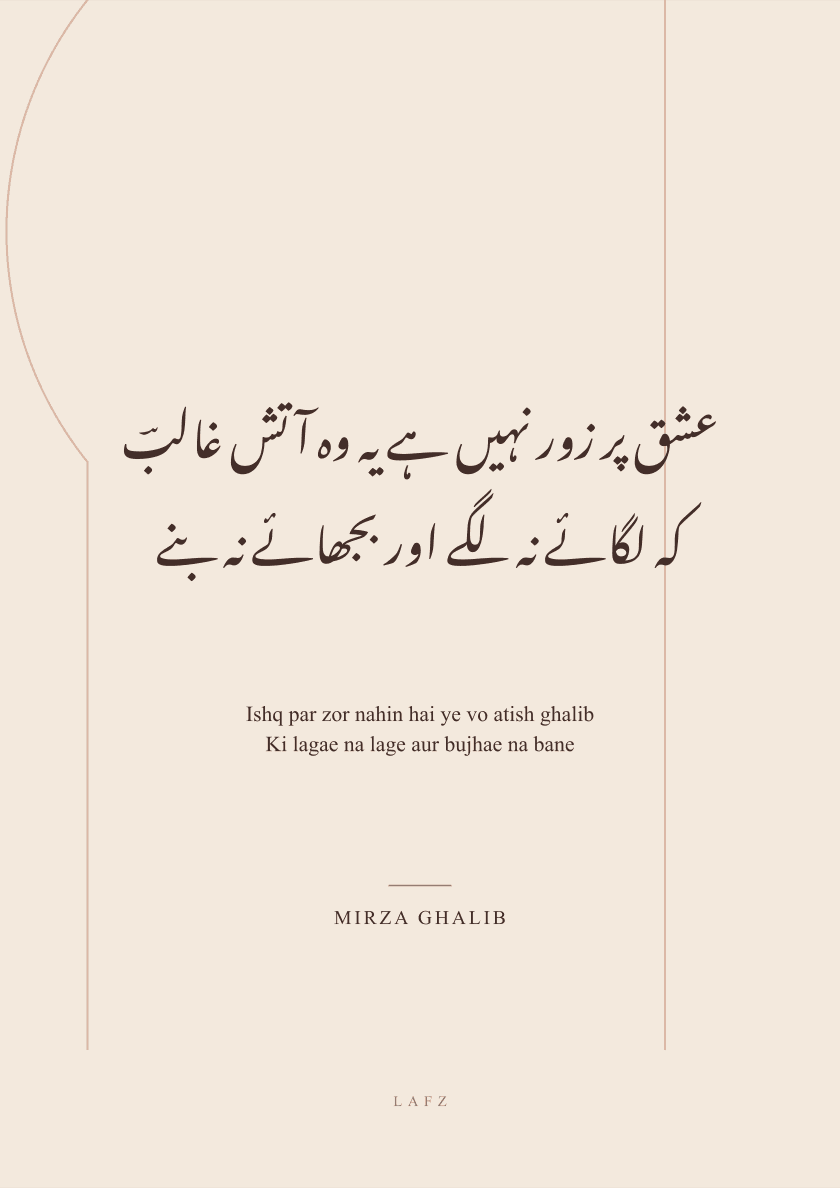
Ishq par zor nahin hai ye vo atish ghalib
Ki lagae na lage aur bujhae na bane
Plain-English meaning: Love cannot be commanded. It is a fire that cannot simply be lit at will or put out when we choose.
The image of fire gives the couplet its force, but the central idea is control. Love does not reliably follow instructions, even our own. That makes this a more complicated romantic verse than a promise of perfect happiness.
As a gift, it may appeal to someone who likes intensity and the unruly side of love. It is less suited to a message that needs to feel uncomplicated or reassuring. Read it with the recipient in mind, rather than choosing it only because the opening mentions love.
See the couplet in its ghazal and the Ishq Par Zor Nahin design.
3. Phir Wahi Fursat: time for remembering
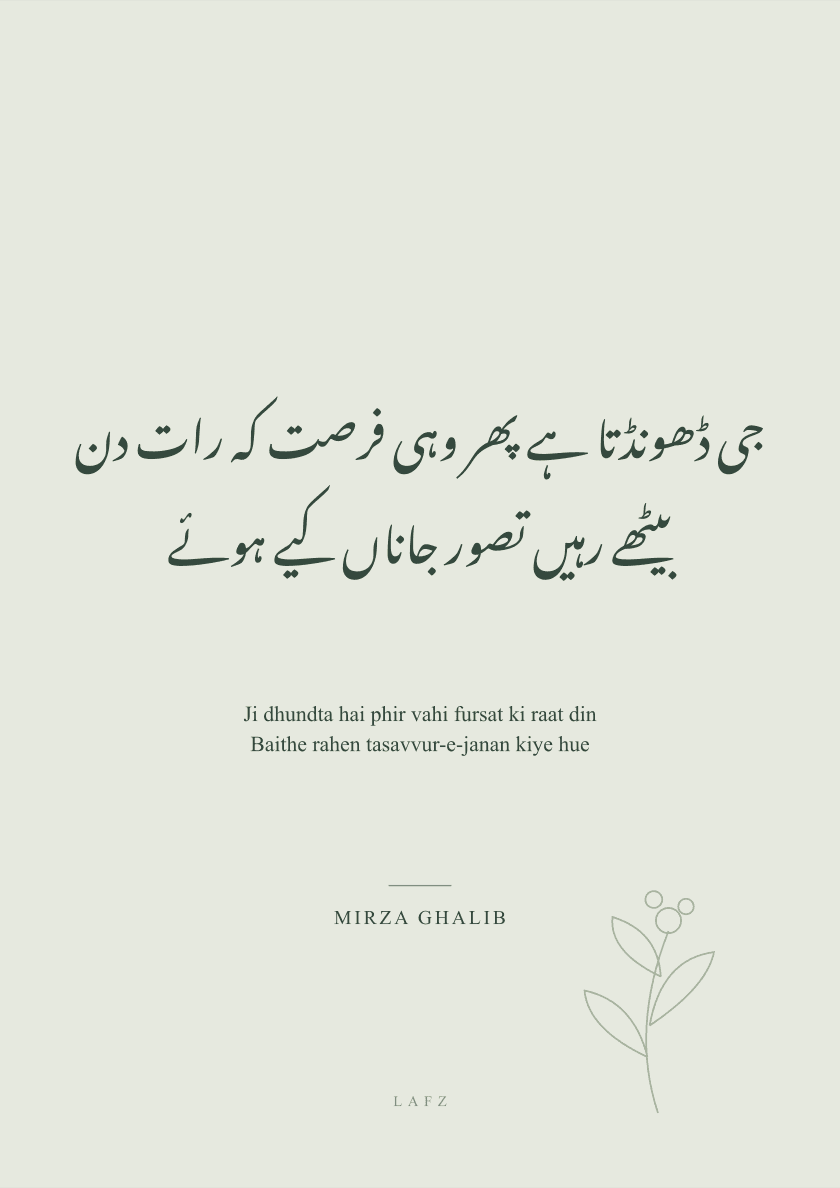
Ji dhundta hai phir vahi fursat ki raat din
Baithe rahen tasavvur-e-janan kiye hue
Plain-English meaning: The heart longs again for that leisure: to sit, day and night, absorbed in imagining the beloved.
Here, leisure is not merely an empty diary. It is the time and inward space to remain with a thought. The beloved is present through imagination, which gives the verse both tenderness and distance.
This makes it a thoughtful choice for a reading corner or a place where you slow down. The Sage Herbarium design pairs that reflective mood with a quiet botanical accent. The connection between mood and design is our editorial choice, not a claim about the poet's original setting.
The source ghazal uses the opening reproduced here. Familiar adaptations can differ, so check the wording when choosing a Phir Wahi Fursat print.
Which Ghalib print should you choose?
Choose Hazaaron Khwahishen for reflection on wanting, Ishq Par Zor Nahin for love's intensity, or Phir Wahi Fursat for a quieter sense of longing. Then look at the room, the script size and the person who will read it.
Our poetry wall-art guide can help with those practical decisions.
Common questions
Are these complete poems?
No. Each quotation is a two-line couplet from a longer ghazal. The source links lead to the surrounding work.
Is the English meaning a literal translation?
No. It is an original prose explanation intended to help a new reader. It cannot reproduce every shade of the Urdu or replace a fuller literary reading.
Do different Roman Urdu spellings change the poem?
Not necessarily. Spellings such as khvahish and khwahish may represent the same Urdu word. Check the original script and literary source when the wording itself is in doubt.
Browse all Ghalib prints to compare the words and designs together.